
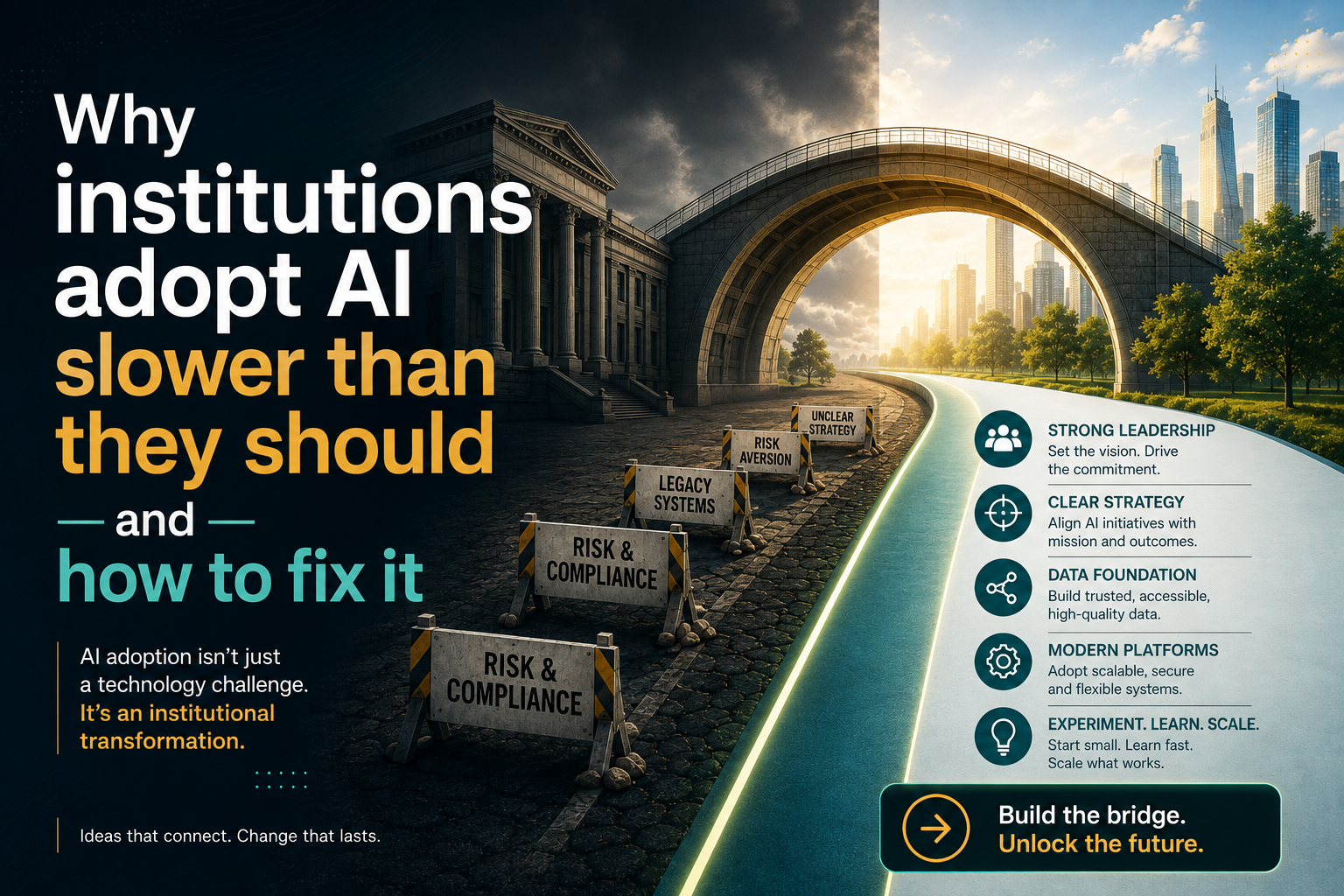
There is a pattern that repeats across almost every institution that approaches AI adoption seriously. Leadership sees the potential. A pilot gets approved. The technology is procured or built. And then — almost nothing changes at the operational level.
The temptation is to diagnose this as a technology problem. The model wasn't accurate enough. The integration was too complex. The vendor oversold it. Sometimes those things are true. But more often, the bottleneck isn't the AI at all. It's the gap between what the technology can do and what the people who are supposed to use it actually trust it to do.
The trust problem is a fluency problem
Institutional staff — program officers, data managers, analysts, administrators — are being asked to trust outputs from systems they have never had the chance to learn. Not learn in a training session sense. Learn in the sense of having spent time with a tool, made mistakes with it, seen where it works and where it doesn't, and developed an intuition for when to rely on it and when to check its work.
That kind of fluency doesn't come from a workshop. It comes from use. And the problem is that most AI adoption programs skip the use phase entirely. They go straight from procurement to deployment, hand the tool to people who have never touched it, and then measure adoption rates three months later and wonder why they're low.
The result is predictable. Staff find workarounds. They use the AI to generate a first draft and then rewrite it entirely. They run the model's output and then do the calculation again manually to check it. They adopt the tool nominally — it appears in their workflow — but they don't actually rely on it for anything they care about getting right.
This isn't irrational. It's what any reasonable person does when asked to trust something they don't understand.
What actually builds fluency
The institutions that get AI adoption right do something different. They create space — structured, low-stakes space — for their staff to build a relationship with the technology before it matters.
This looks like different things in different contexts. Sometimes it's a six-week internal AI training program where participants work through real problems from their own roles using AI tools, with enough time to fail and recover before anything is at stake. Sometimes it's a deliberate pilot in a low-consequence domain — not the donor report, but the internal briefing note; not the budget model, but the first-pass analysis that a senior person will review anyway.
The common thread is that fluency has to be earned through experience, not conferred through instruction. You cannot teach someone to trust a tool. You can only give them enough experience with it that they develop trust on their own terms.
The institutional dimension
There is one more layer that is specific to institutions — government ministries, NGOs, international organizations — that doesn't apply in the same way to commercial companies.
In institutional settings, the cost of a visible mistake is asymmetric. A wrong output in a donor report, a misclassified beneficiary record, an AI-generated analysis that turns out to be incorrect — these don't just create operational problems. They create political problems. They create audit findings. They create the kind of scrutiny that makes future AI adoption harder, not easier.
This means that institutional staff are not being paranoid when they're cautious about AI outputs. They are correctly reading the incentive structure they operate in. An adoption program that doesn't account for this — that treats institutional caution as ignorance to be overcome rather than a rational response to a real risk environment — will fail on its own terms.
The fix is not to lower the caution. It's to build enough fluency that staff can apply their caution intelligently — knowing when the AI output is reliable enough to use and when it needs to be checked, rather than defaulting to checking everything or trusting everything.
What this means in practice
For any institution planning an AI adoption initiative, the implication is straightforward: the training program is not a prelude to the real work. It is the real work.
Building staff fluency — structured, hands-on, grounded in actual job functions — is the highest-leverage investment an institution can make in AI adoption. The technology will keep improving. The integration challenges will get easier. The thing that doesn't improve on its own is the human relationship with the tool.
That relationship has to be built deliberately, at the pace at which trust is actually earned. Institutions that understand this ship AI that works. Institutions that skip it ship AI that sits.